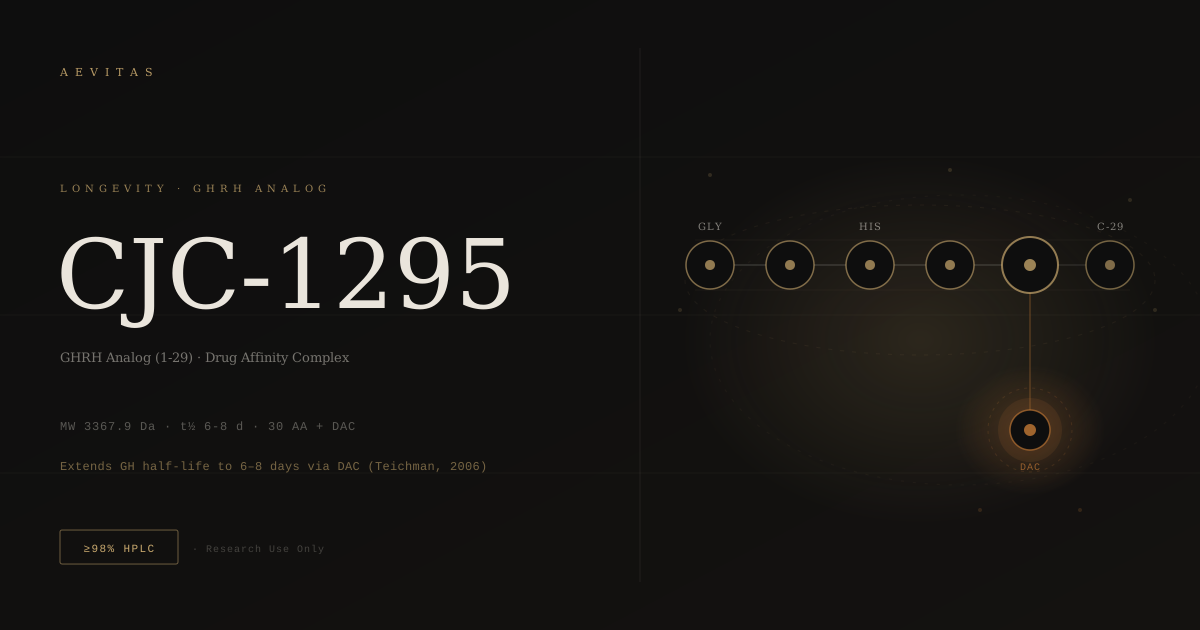
CJC-1295 (Modified GRF 1-29, No DAC)
CJC-1295 (Modified GRF 1-29) is a protease-resistant GHRH analog with a 30-minute plasma half-life that provides sustained GHRH receptor stimulation and is most commonly stacked with Ipamorelin for synergistic GH pulse amplification.
- Half-life
- 0.5 h
- MW
- 3367.9
- Purity
- 98.4%
- Sequence
- YADAIFTNSYRKVLGQLSARKLLQDIMSRQ
Mechanism
CJC-1295 without DAC (also termed Modified GRF 1-29 or Mod-GRF) is a 29-amino-acid GHRH analog with four amino acid substitutions at positions 2 (Ala→Aib), 8 (Gln→Ala), 15 (Ala→Aib), and 27 (Leu→Nle) that resist enzymatic cleavage by dipeptidylpeptidase IV (DPP-IV) and other serum proteases. These substitutions extend plasma half-life from ~2 minutes (native GHRH 1-29) to ~30 minutes without the continuous-release DAC (drug affinity complex) modification. Like Sermorelin, CJC-1295 acts as a full GHRH receptor (GHRHR) agonist on pituitary somatotrophs, activating adenylate cyclase and cAMP-mediated GH release. Its extended half-life allows more complete receptor activation per injection compared to native GHRH. Jette et al. (2005, PMID: 16352683) documented dose-dependent GH elevation and IGF-1 increase in healthy adults, with a duration of GH effect of 6+ hours after a single subcutaneous administration.
What is CJC-1295?
CJC-1295 (without DAC) — also known as Modified GRF 1-29 or Mod-GRF — is a protease-resistant 29-amino-acid GHRH analog that stimulates physiological GH release with a plasma half-life of approximately 30 minutes, making it the preferred GHRH-axis partner for Ipamorelin in dual-receptor GH research stacks. By substituting four amino acids in the native GHRH 1-29 sequence to resist DPP-IV and serum protease cleavage, CJC-1295 achieves the receptor activation duration necessary for meaningful GH pulse stimulation without the weeks-long half-life of the DAC (drug affinity complex) variant that produces continuous — rather than pulsatile — GH release.
Mechanism of Action
CJC-1295 is a full agonist at the GHRH receptor (GHRHR) on anterior pituitary somatotrophs. Receptor binding raises intracellular cAMP via adenylate cyclase activation, triggering GH gene transcription, synthesis, and pulsatile secretion — identical in mechanism to Sermorelin and endogenous GHRH.
The critical difference from native GHRH 1-29 (half-life ~2 minutes) and Sermorelin (44 AA, ~10–20 min) is structural resistance to enzymatic degradation. Four amino acid substitutions — Ala²→Aib, Gln⁸→Ala, Ala¹⁵→Aib, Leu²⁷→Nle — prevent DPP-IV cleavage at the N-terminal dipeptide, the primary rapid-inactivation mechanism for native GHRH in plasma.
The consequence is a half-life of ~30 minutes (no DAC), sufficient for robust GHRHR stimulation with a single injection while still being short enough to preserve pulsatile GH physiology. This distinguishes CJC-1295 (no DAC) from CJC-1295 with DAC, whose half-life of ~8 days produces supraphysiological GH elevation incompatible with physiological pulsatility research.
When combined with Ipamorelin, CJC-1295 and Ipamorelin simultaneously activate GHRHR and GHSR-1a respectively — the two primary positive regulators of GH secretion — producing synergistic GH pulse amplification documented to exceed either peptide's individual effect.
Key mechanistic features:
- GHRHR full agonism — Identical receptor binding to Sermorelin and endogenous GHRH
- DPP-IV resistance — Four substitutions extend plasma stability from 2 min to ~30 min
- Pulsatile GH preservation — Short enough half-life to maintain physiological GH pattern
- CJC/Ipamorelin synergy — Dual GHRHR + GHSR-1a activation amplifies GH pulse amplitude
- IGF-1 stimulation — Secondary hepatic IGF-1 response to elevated GH
Key Research
Jette et al., 2005 (J. Clin. Endocrinol. Metab., PMID: 16352683) — The pivotal characterisation study. Administered CJC-1295 (no DAC) to healthy adults across dose ranges and documented dose-dependent GH elevation, extended duration of GH effect (~6+ hours per injection), and downstream IGF-1 increase. Established CJC-1295 as a validated GHRH-axis research tool superior in duration to native GHRH while preserving pulsatility.
Research Applications
Researchers studying CJC-1295 typically investigate:
- GHRHR activation kinetics — Dose-response, duration of GH effect, receptor occupation
- CJC + Ipamorelin stacks — Synergistic GH amplification and downstream IGF-1 effects
- Body composition — Lean mass preservation, adipose modulation in GH-deficient models
- Comparison with Sermorelin — Half-life and receptor activation duration differences
Physical Properties
| Property | Value |
|---|---|
| Sequence | YADAIFTNSYRKVLGQLSARKLLQDIMSRQ (modified; 4 non-standard residue substitutions) |
| Molecular weight | 3,367.9 Da |
| Half-life | ~30 minutes (no DAC variant) |
| Purity (Aevitas) | ≥98% HPLC |
| Storage | −20°C, desiccated; lyophilized stable 24+ months |
| Form | Lyophilized powder |
Frequently Asked Questions
What is CJC-1295 used for in research? CJC-1295 is used to study GHRH receptor activation with extended plasma stability, and as the GHRH-axis component of the widely studied Ipamorelin + CJC-1295 dual-receptor GH stack. Its 30-minute half-life (no DAC) makes it the preferred GHRH research tool for studies of pulsatile GH physiology.
What is the difference between CJC-1295 with and without DAC? CJC-1295 without DAC (Modified GRF 1-29) has a ~30-minute half-life and produces pulsatile GH release — the physiologically normal pattern. CJC-1295 with DAC binds covalently to albumin, giving a ~8-day half-life and continuous GH elevation. For most anti-aging GH research, the no-DAC form is preferred because it models normal GH pulsatility. The DAC form is used in studies specifically investigating sustained, non-pulsatile GH receptor stimulation.
How does CJC-1295 compare to Sermorelin? Both are GHRHR full agonists. Sermorelin is the full 44-amino-acid GHRH sequence with a ~15-minute half-life. CJC-1295 (no DAC) is a modified 29-AA sequence with a ~30-minute half-life due to DPP-IV resistance. CJC-1295 provides longer receptor activation per injection. Sermorelin's longer sequence more closely mirrors endogenous GHRH structure.
Is Aevitas CJC-1295 research-grade? Yes. Aevitas CJC-1295 (no DAC) is supplied at ≥98% HPLC purity, verified by a third-party laboratory. Every batch ships with a numbered certificate of analysis. Research Use Only — not for human consumption.
Aevitas CJC-1295 — Research Grade
Aevitas supplies CJC-1295 (no DAC) as a lyophilized powder at ≥98% HPLC purity, independently verified by a third-party laboratory. Every batch ships with its certificate of analysis.
Research Use Only — Not for human consumption.
Browse Longevity Protocols → | View COA Library → | [Order CJC-1295 →](/product/cjc-1295-2mg)
Related resources