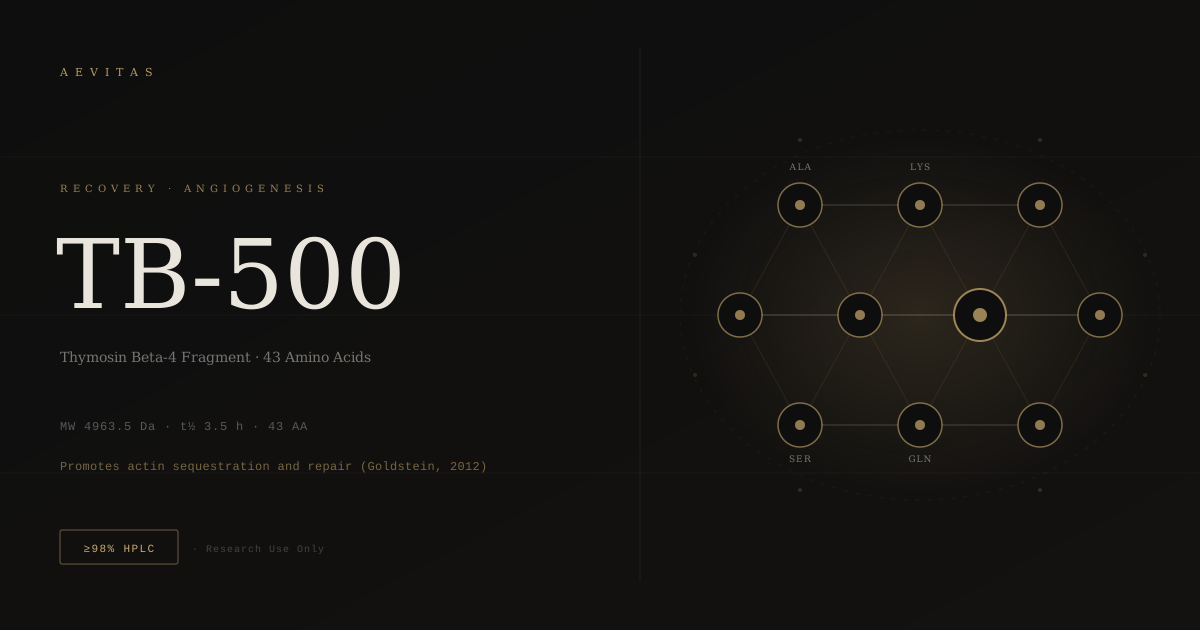
TB-500 (Thymosin Beta-4 Synthetic)
TB-500 is a synthetic analog of Thymosin Beta-4, a 43-amino-acid intracellular protein that regulates actin polymerisation to promote cell migration, angiogenesis, and tissue repair. Studied for musculoskeletal regeneration, cardiac repair, and wound healing.
- Half-life
- 3.5 h
- MW
- 4963.5
- Purity
- 98.3%
- Sequence
- LSDKPDMAEIEKFDKSKLKKTEREQGGHSPASAGNQQPILKPEAKPTQHEEDL
Mechanism
TB-500 is a synthetic version of Thymosin Beta-4 (Tβ4), a 43-amino-acid ubiquitous intracellular protein that sequesters G-actin monomers and regulates actin polymerisation dynamics. By maintaining a large pool of unpolymerised actin, Tβ4 enables rapid cytoskeletal remodeling in response to wound signals. Its primary repair mechanism is promotion of cell migration: Tβ4 activates ILK (integrin-linked kinase), which in turn activates Akt/PKB and downstream ERK1/2 signalling pathways that drive endothelial cell, cardiomyocyte, and muscle satellite cell migration into injury sites. Tβ4 also upregulates MMP-2 for extracellular matrix remodeling and promotes angiogenesis via VEGF pathway activation. Goldstein & Kleinman (2015, PMID: 25917514) summarise evidence of cardiac, musculoskeletal, corneal, and neurological repair across multiple model systems.
What is TB-500?
TB-500 is a synthetic analog of Thymosin Beta-4 (Tβ4), a 43-amino-acid ubiquitous intracellular protein that sequesters G-actin monomers to regulate cytoskeletal dynamics and promote cell migration, angiogenesis, and tissue repair across cardiac, musculoskeletal, corneal, and neurological injury models. Thymosin Beta-4 was first isolated from thymus tissue in the 1960s but has since been found in virtually all nucleated cells, with particularly high concentrations in platelets and wound fluid — consistent with its central role in injury response. Goldstein & Kleinman (2015, PMID: 25917514) characterise Tβ4 as one of the most promising tissue repair agents yet identified, with evidence across multiple organ systems and injury types.
Mechanism of Action
Thymosin Beta-4 acts primarily through actin sequestration. By binding G-actin (unpolymerised actin monomers) in a 1:1 complex, Tβ4 maintains a large, rapidly mobilisable pool of actin available for cytoskeletal remodeling when cells receive migratory or repair signals. This enables the rapid formation of lamellipodia and filopodia necessary for cell migration into injury sites.
Beyond actin sequestration, Tβ4 activates integrin-linked kinase (ILK), which drives Akt/PKB and ERK1/2 signalling — pathways central to cell survival, proliferation, and migration. This signalling cascade has been documented in endothelial cells, cardiomyocytes, muscle satellite cells, and dermal fibroblasts.
Key mechanistic effects:
- G-actin sequestration — Maintains mobile actin pool for rapid cytoskeletal remodeling
- ILK-Akt-ERK signalling — Promotes cell survival and migration in injured tissue
- Angiogenesis — VEGF pathway upregulation; documented endothelial tube formation
- MMP-2 activation — Extracellular matrix remodeling to clear debris and enable cell migration
- Cardiomyocyte protection — Reduced apoptosis and improved cardiac function in MI models
- Muscle satellite cell activation — Enhanced regeneration in skeletal muscle injury models
Key Research
Goldstein & Kleinman, 2015 (Acta Physiol., PMID: 25917514) — Comprehensive review documenting Tβ4's repair effects across cardiac, musculoskeletal, skin, corneal, and neurological models. Identifies ILK as the key signalling node and discusses the pathway from laboratory findings to clinical interest.
Bock-Marquette et al., 2004 (Nature, PMID: 15300239) — Demonstrated that Tβ4 significantly reduces cardiac infarct size and improves heart function when administered after myocardial infarction in mouse models, through cardiomyocyte survival and vessel formation.
Goldstein et al., 2005 (Ann. N.Y. Acad. Sci., PMID: 15853759) — Showed Tβ4 promotes corneal repair, neurite outgrowth, and hair follicle development, establishing its multi-tissue repair profile beyond the musculoskeletal system.
Research Applications
Researchers studying TB-500/Tβ4 typically investigate:
- Skeletal muscle repair — Satellite cell activation, myofibre regeneration, force production recovery
- Cardiac repair — Infarct size reduction, cardiomyocyte survival, functional recovery
- Tendon and ligament healing — Fibroblast migration, collagen organisation
- Corneal wound healing — Epithelial closure rate, stromal remodeling
- Neurological recovery — Axon sprouting, neuroinflammation reduction
Physical Properties
| Property | Value |
|---|---|
| Sequence | Full Tβ4: 43 amino acids (LSDKPDMAEIEKFDKSKLKKTEREQGGHSPASAGNQQPILKPEAKPTQHEEDL) |
| Molecular weight | 4,963.5 Da |
| Half-life | ~3–4 hours |
| Purity (Aevitas) | ≥98% HPLC |
| Storage | −20°C, desiccated; lyophilized stable 24+ months |
| Form | Lyophilized powder |
Frequently Asked Questions
What is TB-500 used for in research? TB-500 is studied primarily for musculoskeletal repair, cardiac regeneration, and wound healing. It is frequently combined with BPC-157 in recovery research stacks because the two peptides act through complementary mechanisms: BPC-157 through VEGF and NO pathways, Tβ4 through actin dynamics and ILK signalling.
How does TB-500 compare to BPC-157? BPC-157 and TB-500 are the two most studied recovery peptides and act through distinct mechanisms. BPC-157 is more established for GI healing, tendon-to-bone repair, and neurological modulation. TB-500 has stronger evidence for cardiac repair and muscle satellite cell activation. Many researchers use both together. See the [BPC-157 vs TB-500 comparison](/compare) for a detailed side-by-side analysis.
What are the best injectable peptides for musculoskeletal recovery? BPC-157 and TB-500 are the most studied injectable peptides for musculoskeletal recovery research. BPC-157 targets vascular and fibroblast pathways; TB-500 targets actin cytoskeletal dynamics and ILK signalling. They are complementary in mechanism and are frequently combined in research protocols.
Is Aevitas TB-500 research-grade? Yes. Aevitas TB-500 is supplied at ≥98% HPLC purity, verified by a third-party laboratory. Every batch ships with a numbered certificate of analysis. Research Use Only — not for human consumption.
Aevitas TB-500 — Research Grade
Aevitas supplies TB-500 as a lyophilized powder at ≥98% HPLC purity, independently verified by a third-party laboratory. Every batch ships with its certificate of analysis.
Research Use Only — Not for human consumption.
Browse Recovery Protocols → | View COA Library → | [Order TB-500 →](/product/tb-500-5mg)